
Best All-in-One AI Study Tools for Complete Exam Preparation
Preparing for an exam with five disconnected apps sounds efficient until it isn’t. One tool summarizes your PDF, another makes flashcards, a third answers questions, and a fourth tries to build quizzes. By the time you have stitched everything together, your attention is gone.
That is why more learners are now looking for an AI study platform that can support the full prep cycle in one place: upload material, organize knowledge, build a plan, test understanding, identify gaps, and adapt the next study step automatically.
This matters for more than just college students. Graduate learners, IELTS candidates, certification seekers, busy professionals, educators, and knowledge creators all benefit when the study workflow is unified instead of fragmented.
In this guide, we compare leading tools that claim to be all-in-one. We also draw a hard line between a true end-to-end exam prep system and a single-purpose tool wearing broader marketing language.
"A survey conducted by the Higher Education Policy Institute (HEPI) in February 2025 revealed that 92% of full-time undergraduate students reported using AI in some form, a substantial rise from 66% in 2024." - ERIC - Student Generative AI Survey 2025
What Competitor Articles Get Right - and What They Usually Miss
After reviewing top-ranking competitor content, several patterns show up repeatedly.
Common strengths in competitor coverage
Most articles do a decent job of:
highlighting flashcards, summaries, and quizzes
emphasizing active recall and faster review
showcasing upload flexibility like PDFs, videos, and links
positioning AI tutors as 24/7 support
comparing traditional studying with AI-assisted workflows
Common content gaps
Where most articles fall short is in evaluating what actually makes an all in one AI study app useful for complete exam preparation:
They blur categories.
A summarizer, chatbot, or flashcard maker is not automatically a complete study system.They rarely assess feature integration.
It matters whether notes, quizzes, flashcards, and plans work together or live as isolated outputs.They gloss over source trust and traceability.
For serious exam prep, especially professional or academic work, answer traceability matters.They underplay adaptive planning.
Generating study materials is different from adjusting your strategy based on knowledge gaps.They ignore suitability for professional exams.
Certification prep often needs deeper structure, source reliability, and longer-term planning than casual class review.They often skip pricing transparency.
“Try free” is not the same as clearly understanding limits and paid value.
This article is designed to close those gaps.
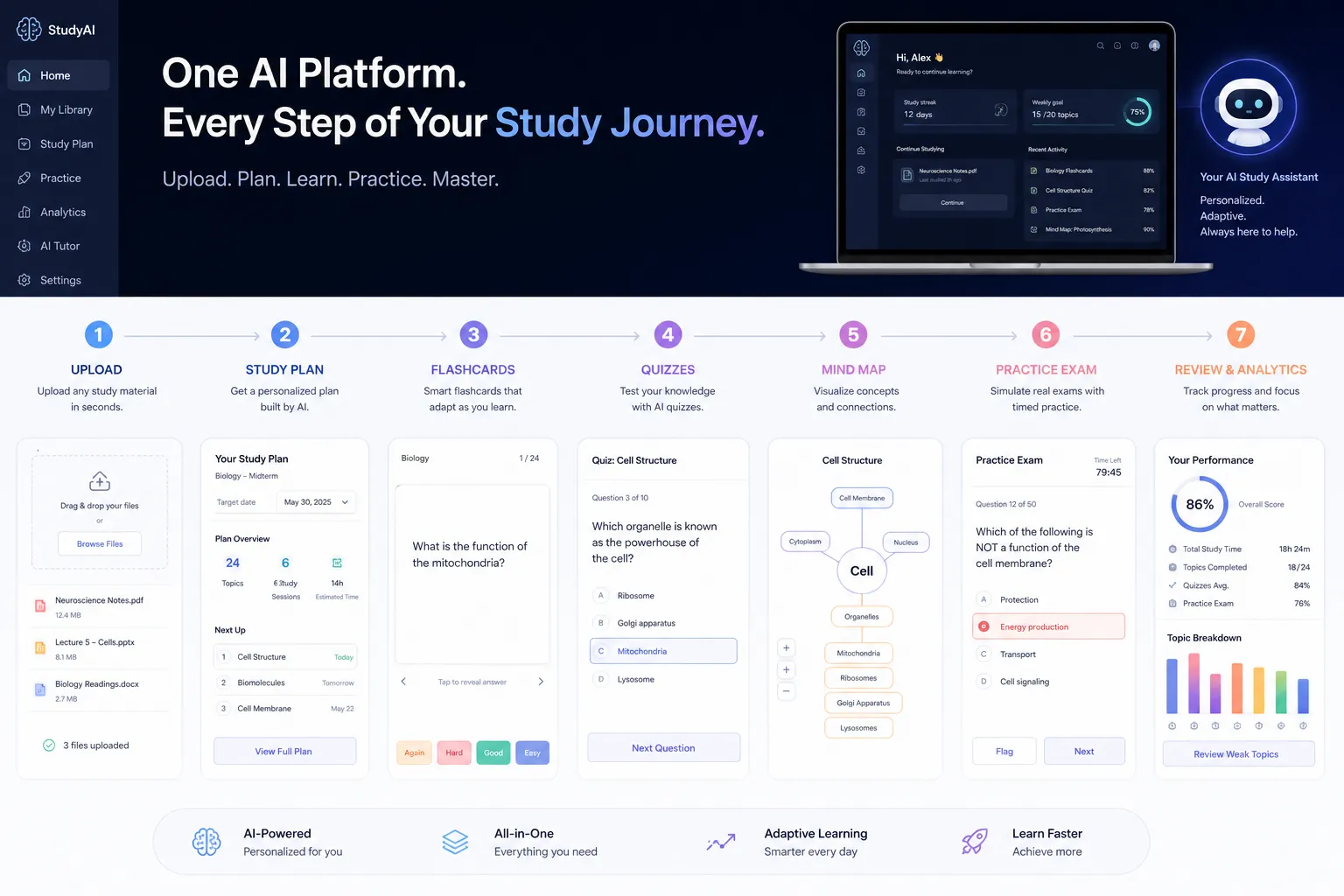
What Counts as a True All-in-One AI Study Platform?
Not every tool in the EdTech market deserves that label.
A true all-in-one platform should cover most of the full study cycle
A strong platform should support:
material ingestion from multiple formats
summarization and note transformation
concept explanation
active recall via flashcards
quiz or test generation
structured knowledge organization
study planning
gap detection
revision support
a connected learning workflow across features
What does not qualify on its own
A tool is not an all-in-one system if it only does one or two of these well:
Tool Type | Useful? | Complete Exam Prep Platform? |
|---|---|---|
AI summarizer | Yes | No |
Flashcard generator | Yes | No |
General chatbot | Yes | No |
Quiz maker | Yes | No |
Note taker | Yes | No |
Integrated multimodal study platform | Yes | Yes |
That distinction is important if your goal is complete preparation rather than isolated productivity boosts.
The Evaluation Framework We Used
To compare the best AI study tools fairly, we used a framework centered on end-to-end exam readiness rather than marketing claims.
Core criteria
Criterion | Why It Matters |
|---|---|
Supported study material formats | Learners use PDFs, slides, links, audio, video, notes, and web sources |
Multimodal handling | The tool should do more than accept formats; it should use them meaningfully |
Study planning | Good prep requires sequencing, not just content generation |
Mind maps and knowledge organization | Helps learners connect ideas instead of memorizing fragments |
Visual explanations | Important for complex or abstract topics |
Flashcards and active recall | Essential for retention |
Quiz generation | Helps learners test understanding early |
Related resources and links | Useful for extending weak areas |
Podcast or audio learning | Helpful for mobile review and accessibility |
Custom note-taking | Important for personalized revision |
Full practice exam generation | Crucial for timed and formal exam prep |
Integration between features | Separate outputs create friction |
Professional exam suitability | Certifications require rigor and structure |
Ease of use and pricing transparency | Important for practical adoption |
Why active recall still matters more than shiny interfaces
"Active recall-based strategies are particularly effective for long-term learning, emphasizing their importance in post-secondary education." - PubMed
The implication is simple: the best AI learning tools do not just explain content. They push you to retrieve, test, and refine it.
The Platforms Evaluated
We focused on platforms that position themselves as broad study systems rather than narrow utilities.
1. CramAI
CramAI is built around a full learning cycle: learn, test, assess, guide, and support. Its positioning is strongest where many tools are weakest: integrating study planning with multimodal materials, traceable answers, connected topic insights, and adaptive strategy updates.
Because it is designed as more than a summarizer or flashcard generator, it is especially relevant for learners who want one workflow from upload to exam simulation.
Where it stands out conceptually
personalized study plans from uploaded materials
support for PDFs, URLs, YouTube, audio, documents, and slides
source-anchored answers with traceability
connected topic relationships for deeper understanding
dynamic assessment and knowledge gap identification
adaptive preparation strategies in real time
creator tools for knowledge organization and content generation
relevance for both individuals and organizations
Best fit
students preparing across multiple subjects
certification and professional exam candidates
educators and creators building reusable knowledge systems
teams needing scalable AI-assisted learning support
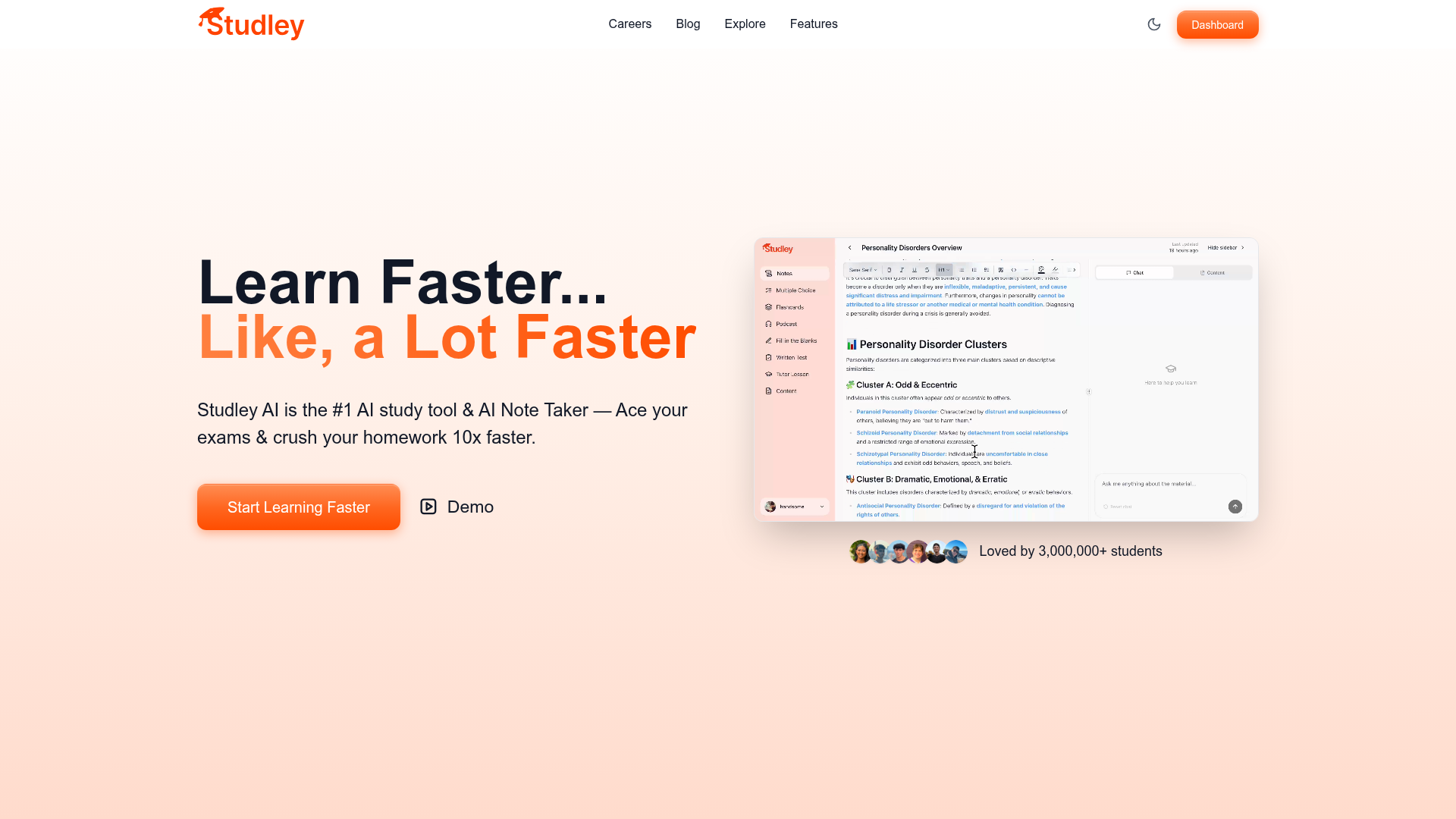
2. Mindgrasp
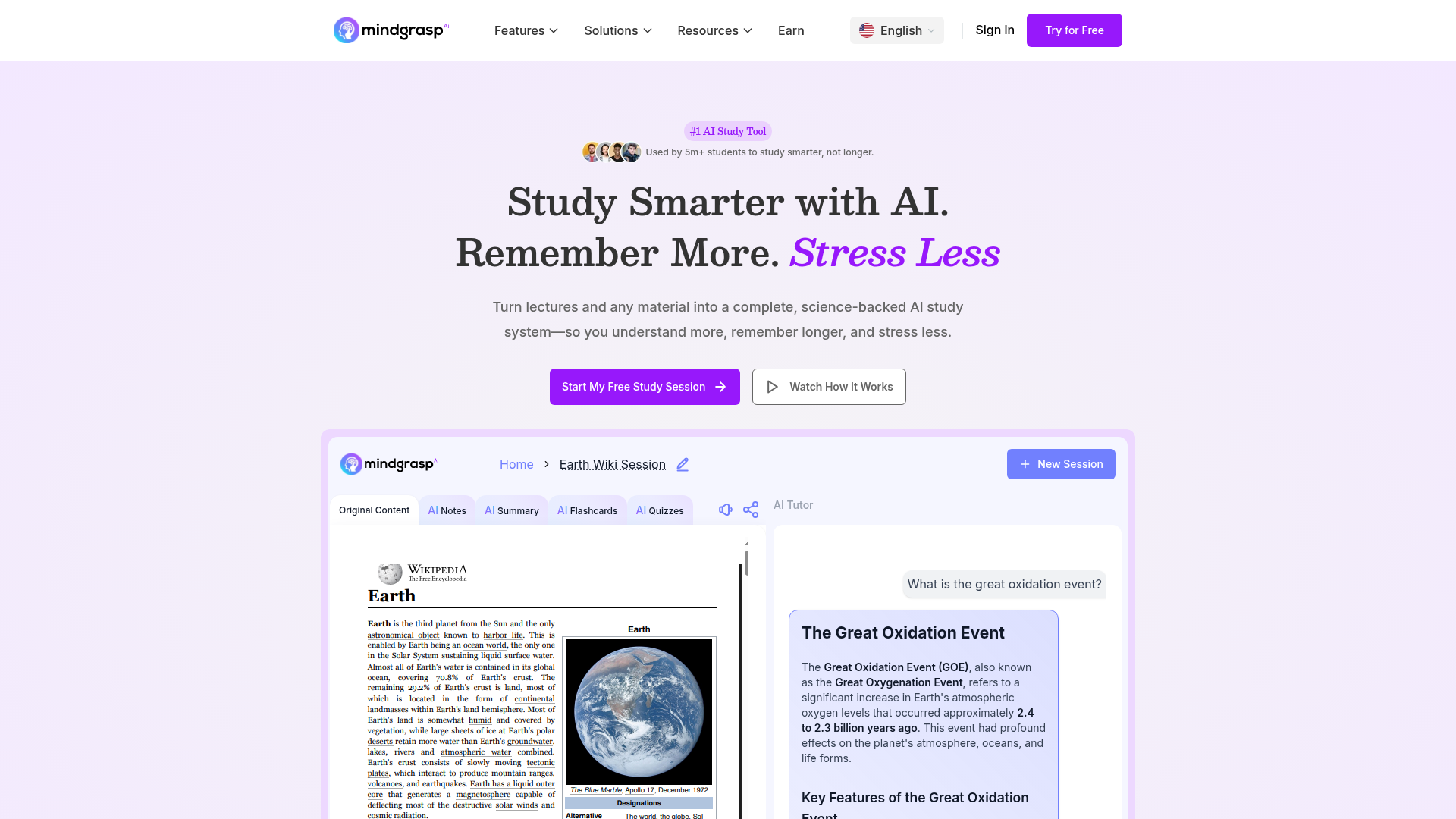
Mindgrasp presents itself clearly as a broad study system, not just a chatbot. Its strongest message is turning uploaded materials into notes, summaries, flashcards, quizzes, and AI tutoring from one study session.
Observed strengths from available public information
broad upload support including PDFs, DOCX, MP3, MP4, PowerPoints, article links, YouTube, and Vimeo
built-in notes, summaries, flashcards, quizzes, and AI tutor
lecture recording workflow
progress tracking per study session
Chrome extension and mobile support
strong positioning around cognitive science concepts
Potential limitations
public messaging emphasizes core study assets more than advanced planning or adaptive strategy orchestration
source traceability and cross-topic concept linking are less emphasized publicly than in some newer platforms
podcast-style learning and mind map capabilities are not central in the current homepage messaging
Best fit
students who want fast conversion of class materials into review assets
learners who value convenience and multimodal ingestion
users who prefer a session-based workflow
3. Studley AI
Studley also positions itself as a broad study tool, with strong emphasis on transforming documents, videos, and notes into flashcards, quizzes, written tests, tutor support, podcasts, and grading assistance.
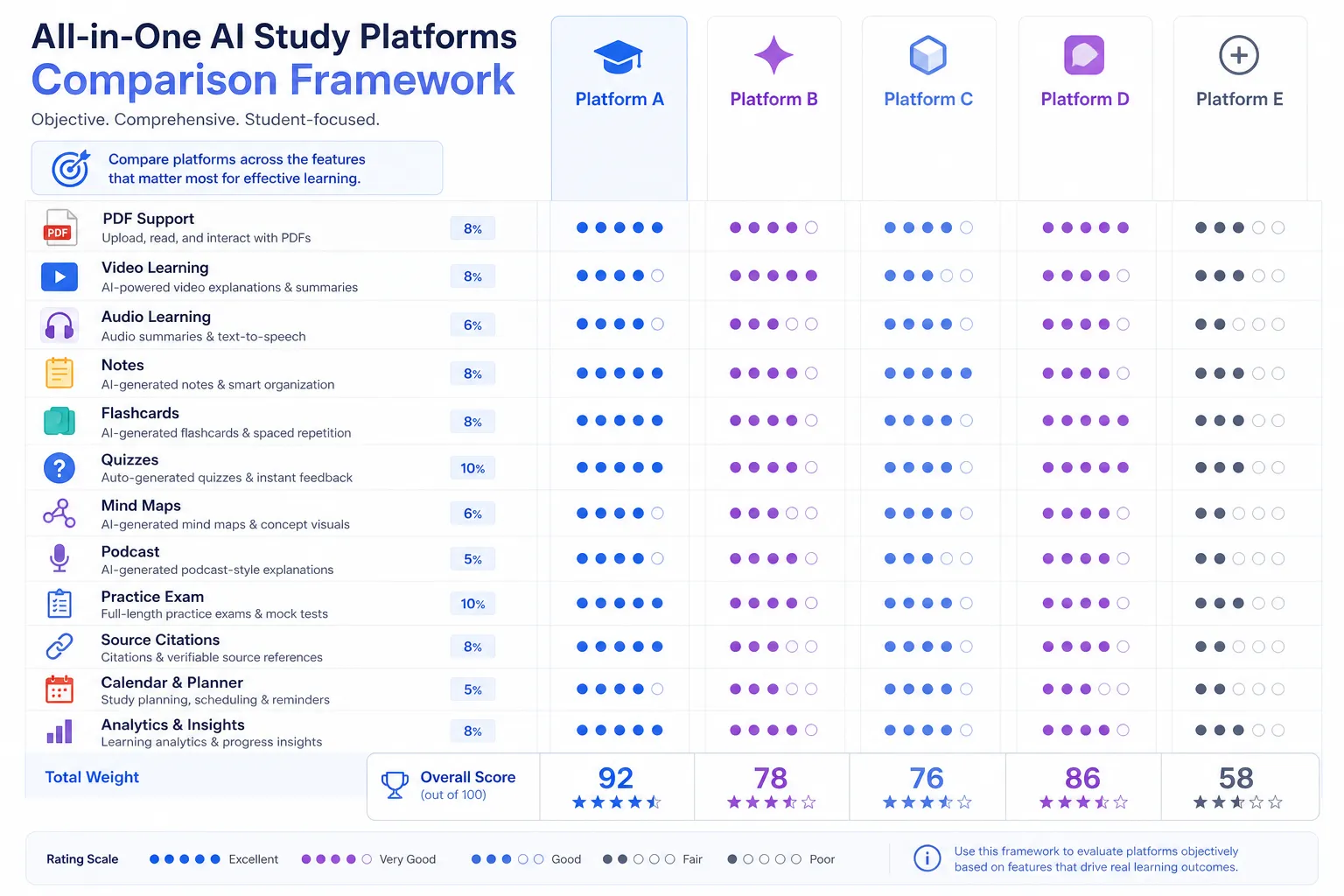
Observed strengths from available public information
supports docs, lecture recordings, YouTube videos, articles, and text input
flashcards, quizzes, written tests, tutor lessons, fill-in-the-blanks, and audio podcasts
essay grading feature
progress tracking orientation
mobile app availability
Potential limitations
the platform messaging focuses heavily on output generation and speed rather than trust architecture or source traceability
advanced study planning and adaptive exam strategy are not as clearly foregrounded
knowledge mapping and concept linking are not core public differentiators
Best fit
students who want many study output formats in one place
learners who enjoy audio learning alongside flashcards and quizzes
users seeking a broad feature set for general academic study
Side-by-Side Comparison Table
Because public product pages do not always expose every detail equally, the table below reflects verified public positioning from the material reviewed. Where a feature is not clearly demonstrated, it is marked conservatively.
Feature / Criterion | CramAI | Mindgrasp | Studley AI |
|---|---|---|---|
PDFs and documents | Yes | Yes | Yes |
Web URLs | Yes | Yes | Yes |
YouTube input | Yes | Yes | Yes |
Audio input | Yes | Yes | Yes |
Slides / presentations | Yes | Yes | Yes |
Multimodal handling | Strong | Strong | Strong |
AI summaries | Yes | Yes | Yes |
AI notes | Yes | Yes | Yes |
Flashcards | Yes | Yes | Yes |
Quiz generation | Yes | Yes | Yes |
Full practice exams / written tests | Yes | Not clearly emphasized | Yes |
AI tutor / Q&A | Yes | Yes | Yes |
Mind maps / knowledge maps | Yes | Not clearly emphasized | Not clearly emphasized |
Visual explanation layer | Yes | Limited public evidence | Limited public evidence |
Related learning resources / linked exploration | Yes | Partial | Partial |
Source-anchored answers / traceability | Strong differentiator | Limited public emphasis | Limited public emphasis |
Dynamic gap analysis | Yes | Partial | Partial |
Adaptive study planning | Yes | Limited public emphasis | Limited public emphasis |
Podcast / audio learning outputs | Not core public emphasis | Not core public emphasis | Yes |
Custom note workflow | Yes | Yes | Partial |
Creator / knowledge organization tools | Yes | Limited | Limited |
Professional exam suitability | Strong | Moderate | Moderate |
Organization / team scalability | Yes | Not clearly emphasized | Not clearly emphasized |
Pricing transparency on reviewed public pages | Limited public visibility | Limited public visibility | Moderate public visibility |
What the Comparison Actually Means
A feature checklist is useful, but serious learners need interpretation.
If you want the broadest “study assets in one place” experience
Mindgrasp and Studley both do well at turning source material into usable outputs quickly. If your workflow is mostly:
upload
summarize
make flashcards
run quizzes
ask questions
then either can be compelling.
If you want deeper exam strategy, not just content generation
This is where CramAI becomes more interesting. Its differentiators are not just “more tools,” but how those tools connect:
plans built from your own uploaded material
source-anchored answers that reduce blind trust in AI output
linked concepts across topics for deeper understanding
dynamic reassessment that can adjust your next study actions
support for both learner workflows and creator/organization knowledge systems
For advanced exam prep, that integration matters.
If you want audio-first study support
Studley deserves attention for publicly emphasizing podcast and audio learning formats. That can be valuable for commuters, auditory learners, and review on the go.
The Real Difference Between Integrated and Fragmented Study Workflows
A lot of so-called “complete” tools still behave like bundles of separate utilities.
Fragmented workflow
You upload a PDF.
You get a summary.
Then you manually request flashcards.
Then separately generate a quiz.
Then ask a chatbot to explain what you missed.
Then figure out yourself what to study next.
Integrated workflow
You upload your material once.
The platform extracts key concepts.
It builds notes and summary layers.
It identifies topic relationships.
It tests your weak points.
It adapts your study plan.
It gives you traceable explanations from the original material.
It reduces cognitive overhead because the next step is already clear.
That second workflow is where modern AI exam prep tools should be heading.
Recommendations by Learner Type
Not every learner needs the same stack.
For undergraduate and graduate students
Best choice if you want:
one place for lecture slides, readings, notes, and revision assets
strong active recall support
adaptable prep across multiple classes
Good fit: CramAI, Mindgrasp
For certification and professional exam candidates
Best choice if you need:
longer study arcs
trustworthy answers linked to original sources
gap analysis and structured revision plans
support for dense documents and layered understanding
Good fit: CramAI
For fast academic review and lecture-to-study conversion
Best choice if you value:
upload flexibility
quick notes, summaries, flashcards, quizzes
session-based studying with minimal setup
Good fit: Mindgrasp
For learners who want lots of output formats, including audio
Best choice if you enjoy:
podcasts or audio lessons
flashcards plus tests plus tutor support
broad feature variety in one interface
Good fit: Studley AI
For educators, creators, and knowledge teams
Best choice if you need:
structured knowledge organization
content generation workflows
scalable learning systems for individuals or groups
Good fit: CramAI
How to Choose Without Falling for Feature Overload
When comparing the best AI study tools, ask these questions:
1. Does it support your real study materials?
If your prep includes PDFs, videos, slides, links, and audio, your platform should ingest all of them cleanly.
2. Are the features connected?
Flashcards, quizzes, notes, and plans should not feel like separate apps.
3. Can you trust the answers?
For serious prep, traceability beats polished confidence.
4. Does it identify what you do not know?
A strong platform should reveal gaps, not just generate content.
5. Can it scale with your goals?
The right tool for a weekly quiz may not be the right tool for IELTS, CFA-level prep, licensing, or internal enterprise learning.
Final Verdict
If you only need quick summaries or a deck of flashcards, you do not need a full platform.
But if you want complete exam preparation in one environment, the bar is much higher. A serious all-in-one solution should combine multimodal material support, knowledge organization, active recall, testing, reliable explanations, and adaptive guidance.
From the options evaluated here:
Mindgrasp is strong for fast, convenient conversion of source material into study assets.
Studley AI is attractive for learners who want many output types, especially audio and written test formats.
CramAI is especially compelling when your priority is not just generating study materials, but orchestrating the entire exam prep process with source-aware answers, concept linking, dynamic assessments, and adaptive study planning.
That makes CramAI a strong option for learners who want more than isolated AI features. It is particularly well aligned with high-stakes preparation, multi-format study inputs, and learners who want the platform to reduce cognitive load instead of adding another layer of app management.
If you are ready to move from scattered tools to a connected exam prep system, CramAI is worth exploring as your next all-in-one study partner.